Short answer: Your COMT Val158Met (rs4680) genotype tunes how fast your prefrontal cortex clears dopamine. The popular framing splits people into "worriers" (Met/Met) — sharper focus and working memory — and "warriors" (Val/Val) — steadier under pressure but flatter baseline focus, with Val/Met in between. Read that as a hypothesis about cognitive style, not a verdict on your temperament. Neuroimaging supports a real trade-off between cognitive and emotional processing, but meta-analyses of anxiety traits and pain sensitivity find effects that are small, inconsistent, and not always in the direction the nicknames imply.
Check your own COMT: Upload your 23andMe or AncestryDNA raw data to Ask My DNA and see your exact COMT genotype with a personal, plain-language readout. Start free with your first question, no credit card.
Your rs4680 genetic variant fundamentally shapes how your brain handles stress and processes information. The Val158Met substitution in the COMT gene determines whether you're neurologically wired as a "worrier" or "warrior"—and understanding this difference transforms how you approach work, relationships, and personal optimization.
According to research published in the Archives of General Psychiatry (2005), this single amino acid change at position 158 produces enzyme activity differences of 3-4 fold, creating dramatically different baseline dopamine levels and stress responses. In this guide, you'll discover your likely genotype (GG, AG, or AA), how it influences cognition, stress tolerance, pain sensitivity, and medication response—plus practical strategies for career alignment, stress management, and optimization matched to your dopamine metabolism.
Understanding rs4680: The COMT Val158Met Polymorphism
The rs4680 SNP in the COMT gene on chromosome 22 directly impacts how your prefrontal cortex metabolizes dopamine, one of your brain's most critical neurotransmitters. The COMT enzyme (catechol-O-methyltransferase) breaks down dopamine, epinephrine, and norepinephrine—catecholamines central to mood, motivation, focus, and stress response. Your prefrontal cortex operates optimally within a narrow dopamine concentration window. Too little dopamine impairs cognitive function, motivation, and working memory. Too much creates anxiety, distractibility, and cognitive overwhelm. This isn't a simple linear relationship; it's a finely tuned balance.
According to the National Institutes of Health (2024), COMT activity determines your baseline dopamine more than any other single genetic factor in the dopamine system. The COMT gene comes in two common versions at position 158: Val (valine, G allele) and Met (methionine, A allele). These aren't just letters on a genetic test—they represent different amino acids that fundamentally alter the enzyme's three-dimensional structure and catalytic function.
Valine produces a thermostable enzyme with high catalytic activity. This fast enzyme rapidly breaks down catecholamines, maintaining consistently low baseline dopamine in your prefrontal cortex. Methionine produces a less thermostable, slower-acting enzyme that allows dopamine to persist longer in your synapses, maintaining higher baseline levels. This biochemical difference—stemming from a single nucleotide substitution—cascades into profound differences in personality, cognition, and stress response.
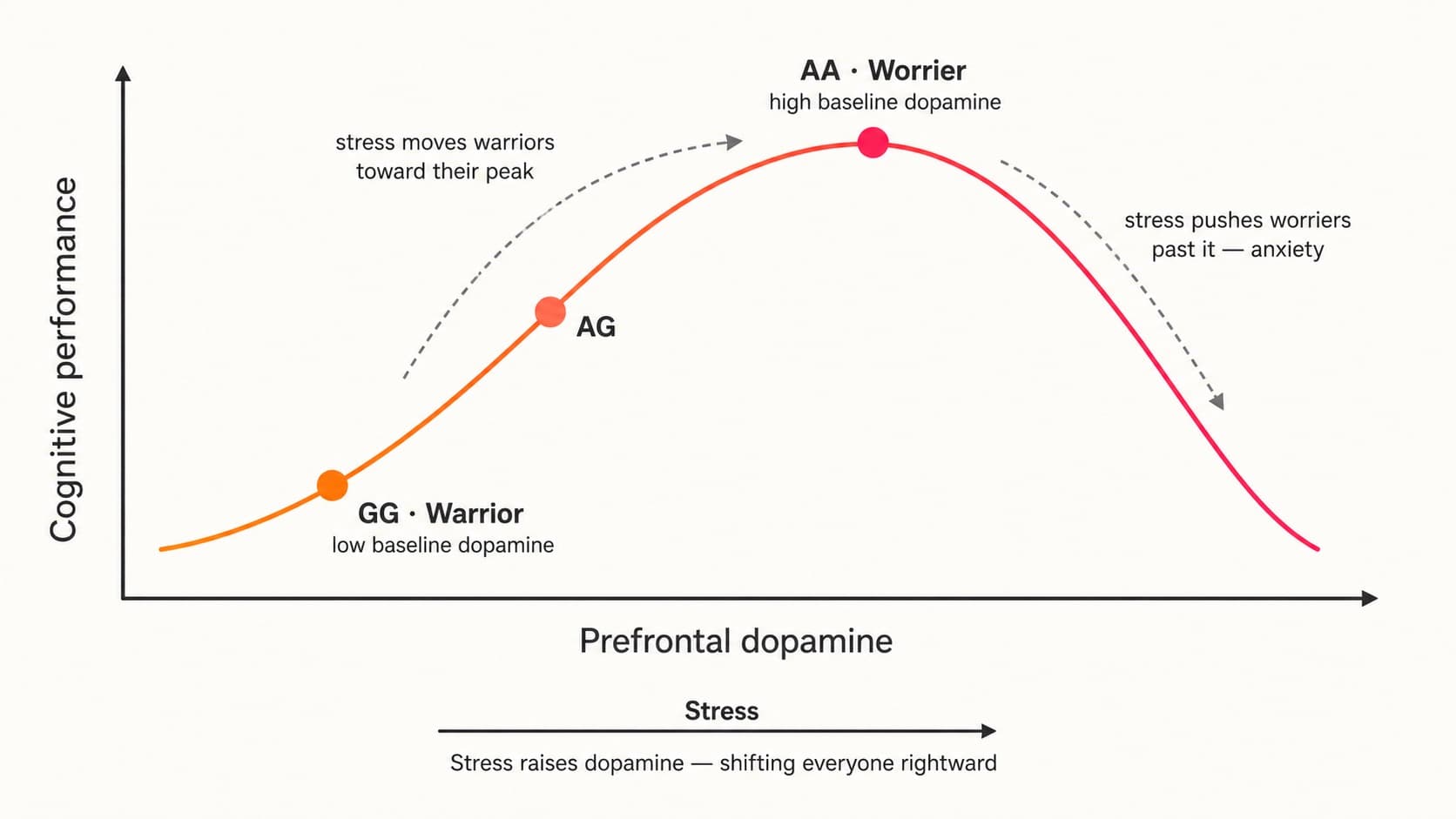
The Yerkes-Dodson law, established through more than a century of psychological research, reveals that cognitive and motor performance follows an inverted-U curve relative to dopamine levels. Performance peaks at an optimal dopamine concentration. Below that level, dopamine insufficiency creates sluggish cognition, poor focus, and low motivation. Above that level, dopamine excess creates anxiety, racing thoughts, and fragmented attention. Your rs4680 genotype determines where you sit on this inverted-U curve.
Val carriers (warriors) start at the lower-left side of the curve—they possess naturally low prefrontal dopamine. In calm, low-stress conditions, this represents a neurochemical disadvantage; their baseline concentration and working memory don't peak. But when stress arrives and naturally elevates dopamine, they move rightward into the optimal range. Their performance actually improves under pressure—stress becomes facilitating rather than impairing.
Met carriers (worriers) start at the higher-right side of the curve—naturally elevated baseline dopamine gives them exceptional focus, working memory, and analytical capability in low-stress conditions. But when stress elevates their dopamine further, they rapidly overshoot the optimal range into the anxiety side of the curve. Pressure becomes impairing.
Heterozygotes (AG) occupy the middle of the curve with greater flexibility to adapt depending on conditions. This geometric difference explains why worriers excel as researchers and analysts, warriors dominate high-pressure environments like emergency medicine and combat, and balanced types succeed across variable-stress conditions.
From the peer-reviewed literature
"Although small in scale, multiple studies demonstrate improvements in working memory after COMT inhibition in a manner dependent on baseline PFC dopamine signaling, consistent with the well-established inverted-U shaped relationship between PFC dopamine signaling and working memory performance."
— Tunbridge EM et al., Boehringer Ingelheim Pharma GmbH & Co. KG, Biberach, Germany. The therapeutic potential of COMT inhibition: cognition and beyond. Mol Psychiatry. 2026. doi:10.1038/s41380-026-03824-9
Research published in Neuropsychopharmacology (2008) demonstrates that Met158 carriers have 3-4 times lower enzyme activity than Val158 carriers—a dramatic functional difference from a single amino acid substitution. This translates to measurable differences in dopamine clearance rates, baseline neural firing patterns, and behavioral outcomes. In European ancestry populations: approximately 25-30% carry the Val/Val (GG) genotype (warriors), 45-50% carry Val/Met (AG) (balanced), and 20-25% carry Met/Met (AA) (worriers). These frequencies vary significantly by ancestral background, with some populations showing different distributions reflecting historical selection pressures.
Understanding your rs4680 genotype means understanding how your brain is literally wired to respond to challenge and stress. Ask My DNA lets you explore your exact COMT Val158Met genotype and understand your personal dopamine baseline, revealing why you respond to pressure the way you do and how to structure your environment for optimal function.
Worrier vs Warrior: How rs4680 Affects Your Brain
The "worrier vs warrior" framework captures fundamental truths about how rs4680 shapes psychology. These aren't personality types you develop—they're neurological predispositions rooted in dopamine function.
From the peer-reviewed literature
"In behavior, pleiotropic action of a functional Val(158)Met (rs4680) polymorphism on executive cognition and emotional stability has been described and proposed to be of evolutionary significance (the 'warrior/worrier' hypothesis)."
— Mier D et al., Central Institute of Mental Health, Mannheim, Germany. Neural substrates of pleiotropic action of genetic variation in COMT: a meta-analysis. Mol Psychiatry. 2010. doi:10.1038/mp.2009.36
The Worrier Phenotype (AA - Met158Met)
Met158Met carriers (20-25% of European ancestry) show elevated baseline dopamine. The meta-analytic neuroimaging evidence favours Met carriers on executive cognition paradigms, which is the firmest part of the worrier picture: better working memory and detail-oriented processing when conditions are calm.
The second half of the story — that this advantage inverts into anxiety under stress — is the part that has not held up as cleanly. The inverted-U model predicts it, and it is intuitively satisfying, but the trait-level evidence does not confirm that Met/Met carriers are the anxious genotype. A meta-analysis of 27 studies and 15,979 participants found the opposite direction on neuroticism, and found nothing at all in women — covered in detail in the anxiety section below. Treat "worrier" as a label for a cognitive profile, not a prediction that you will be more anxious.
Cognitive advantages make worriers excel in intellectual fields: research, programming, writing, strategic analysis, and detailed technical work.
The Warrior Phenotype (GG - Val158Val)
Val158Val carriers (25-30% of populations) show lower baseline dopamine. Warriors display lower cognitive performance than worriers in calm conditions, but when stress elevates dopamine, they move into optimal range. This creates remarkable stress resilience—warriors maintain performance under pressure where worriers collapse.
Pain sensitivity does differ by genotype, but by far less than the popular figures suggest. COMT was treated as the pain-sensitivity gene for nearly two decades; when the literature was finally pooled — 31 samples and 4,631 participants — the effects of rs4680 on pain thresholds turned out to be small, and present mainly in specific conditions such as fibromyalgia and headache rather than as a general trait.
The mechanistic study behind this is also widely quoted backwards. In the 2003 Science paper, met158 homozygotes showed diminished regional mu-opioid system responses to a pain stressor compared with heterozygotes — accompanied by higher sensory and affective ratings of pain — with opposite effects in val158 homozygotes. It is the weaker endogenous opioid response, not a stronger one, that accompanies the higher pain ratings.
From the peer-reviewed literature
"We performed several meta-analyses including k = 31 samples and n = 4631 participants thereby revealing small effects of rs4680 on pain thresholds in fibromyalgia, headache and across chronic pain conditions."
— Vetterlein A et al., Department of Psychology, University of Bonn, Germany. Are catechol-O-methyltransferase gene polymorphisms genetic markers for pain sensitivity after all? - A review and meta-analysis. Neurosci Biobehav Rev. 2023. doi:10.1016/j.neubiorev.2023.105112
Warriors naturally feel lower anxiety in threatening situations (altered amygdala activation), show faster recovery from negative experiences, and display greater comfort with risk-taking. They excel in high-pressure domains: emergency medicine, sales, entrepreneurship, competitive sports, and crisis leadership.
The Balanced Type (AG - Val158Met)
Heterozygotes (45-50% of populations) occupy the middle with genetic flexibility. AG carriers display worrier-like analysis in calm conditions, but shift toward warrior-like stress resilience under pressure. They excel in variable-stress roles: management, product development, and consulting.
| Aspect | GG (Warrior) | AG (Balanced) | AA (Worrier) |
|---|---|---|---|
| COMT Activity | Very Fast | Intermediate | Very Slow |
| Baseline Dopamine | Low | Moderate | High |
| Stress Resilience | Excellent | Good | Moderate |
| Cognitive Strength | Decision-making | Flexible | Analysis |
| Pain Sensitivity | Slightly lower (small effect) | Intermediate | Slightly higher (small effect) |
| Anxiety Traits | No consistent trait advantage | Intermediate | No consistent trait disadvantage |
| Caffeine Sensitivity | Low | Moderate | High |
| Best Career Fit | High-pressure | Variable-stress | Analytical |
rs4680 Genotypes: How to Optimize Your Type
Your genotype reveals your neurological baseline and optimal environmental conditions.
GG (Val/Val) - Warriors (25-30%): Thrive in emergency medicine, trauma surgery, military operations, sales, entrepreneurship, crisis management, competitive sports. You perform better under pressure. Stress doesn't impair you—it enhances focus. Caffeine (200-400mg daily) is well-tolerated. Tyrosine (500-1000mg) supports your lower dopamine baseline. Embrace challenges and competitive elements.
AG (Val/Met) - Balanced (45-50%): Succeed across variable-stress environments. You have cognitive flexibility—analytical when conditions permit, decisive under pressure. Standard caffeine (100-200mg) works well. Balance dopamine support: light magnesium supplementation as needed. Adapt your approach to context.
AA (Met/Met) - Worriers (20-25%): Excel in research, programming, writing, strategic planning, technical roles requiring deep focus. You shine in stable, low-pressure intellectual work. Avoid high-pressure environments where stress triggers anxiety. Limit caffeine to 50-150mg maximum; avoid afternoon intake. L-Theanine (100-200mg), magnesium (300-400mg), ashwagandha (300-600mg), and methylfolate support your profile. Prioritize stress reduction, predictable routines, and adequate sleep.
These practical distinctions apply specifically to you once you know your genotype. Warriors navigating analytical work can optimize through strategic stimulation. Worriers in high-pressure roles can proactively manage stress before it impairs cognition. Balanced individuals can leverage their flexibility strategically. This is where your genetic knowledge becomes actionable: Ask My DNA helps you discover how your personal rs4680 genotype affects your unique cognitive and stress-response patterns, translating abstract genetic science into concrete personal insights.
Health and Performance Implications
Cognitive Performance Under Stress
Worriers (AA) show superior baseline cognition in calm conditions but 15-20% performance decline under pressure. Warriors (GG) show lower baseline cognition but maintain or improve performance under pressure. This explains why identical stress affects people oppositely—some thrive, others collapse, depending on genotype.
Pain Perception
The genotype difference in pain sensitivity is real but small, and it is a group average rather than a personal prediction. Met/Met carriers show, on average, slightly higher pain sensitivity, alongside a diminished endogenous mu-opioid response to a sustained pain stressor. What this does not license is a dosing rule: the effect sizes are far too small to set an analgesic plan by genotype, and nothing here should override how you actually respond to a given medication. If pain control is a live issue for you, that conversation belongs with your clinician and is driven by your response, not your rs4680 result.
Anxiety and Mood
This is where the worrier/warrior shorthand most often misleads, and it is worth being precise. A meta-analysis of 27 studies and 15,979 participants examined COMT val158met against anxiety-related traits, and did not find that Met/Met carriers are more anxious. Where it found anything, the direction ran the other way: valine homozygotes showed higher neuroticism than methionine homozygotes among White males (effect size 0.13; 95% CI 0.02-0.25), and higher harm avoidance among Asian males (0.43; 95% CI 0.14-0.72).
Two features of that result matter more than its direction. The effects are small — 0.13 is a difference you could never detect in yourself. And no significant associations were found in women at all, with effect sizes shrinking further when studies were pooled across ethnicity or across anxiety traits.
The honest summary: rs4680 is not a useful predictor of your anxiety, in either direction. Anxiety risk is shaped by environment, life history, and many genes acting together, and it remains highly treatable regardless of your genotype.
Caffeine and Medication Response
Caffeine's effects differ dramatically by genotype. Warriors tolerate and benefit from 200-400mg daily. Worriers experience anxiety at 75-150mg. ADHD medication response varies: warriors often need higher stimulant doses; worriers respond well to lower doses. Discuss your genotype with prescribers.
Career and Lifestyle Optimization
Career satisfaction increases when your role matches your dopamine metabolism. Warriors in high-pressure roles thrive; worriers in identical roles often experience burnout despite capability. The opposite is true for analytical work.
Career Alignment:
- Warriors excel: Emergency medicine, trauma surgery, military special operations, competitive sales, startup founding, crisis management, professional athletics, litigation
- Worriers excel: Academic research, programming, technical writing, strategic analysis, library science, philosophy, specialized technical roles
- Balanced (AG): Management, product development, consulting, business development, teaching
Consider your genotype when making career decisions. This isn't a life sentence—your actual experience depends on genotype, environment, life history, and other genes combined. But alignment between genetics and environment determines whether work energizes or depletes you.
Supplementation and Nutrition by Genotype
| Supplement | Warriors (GG) | Balanced (AG) | Worriers (AA) |
|---|---|---|---|
| Caffeine | 200-400mg daily | 100-200mg daily | 50-150mg (limit) |
| L-Theanine | Optional | 100-200mg as needed | 100-200mg with caffeine |
| Magnesium | 200-300mg | 250-350mg | 300-400mg |
| Methylfolate | Standard | Standard | 400-800mcg (higher benefit) |
| Ashwagandha | Optional | 200-300mg | 300-600mg |
| Tyrosine | 500-1000mg daily | Optional | Not recommended |
| Rhodiola | 200-400mg | Optional | Not recommended |
Warriors' low baseline dopamine benefits from tyrosine (dopamine precursor). Worriers' elevated baseline benefits from dopamine-reducing strategies: L-theanine (enhances GABA), magnesium (supports GABA), ashwagandha (adaptogen reducing stress dopamine elevation). Methylfolate supports dopamine methylation—critical for Met158Met carriers.
Special Considerations
ADHD Medication: Warriors often need higher stimulant doses; worriers respond to lower doses. Discuss genotype with your prescriber.
Women's Health: Hormonal cycles affect dopamine-dependent cognition. Worriers often experience worsened anxiety and pain sensitivity during luteal phase (post-ovulation). Menopause-related cognitive changes may reflect changing estrogen-dopamine interactions.
Genetic Testing: rs4680 results from direct-to-consumer genetic companies (23andMe, AncestryDNA) or clinical genetic testing are typically accurate. Talk to a genetic counselor to interpret your results in context of personal and family history.
Caffeine Genetics: Worriers' extreme caffeine sensitivity is well-documented. You're not "weak"—you're neurologically different. Avoiding caffeine often achieves better focus than forcing tolerance.
FAQ
Q: What is the rs4680 genotype?
You have two copies of the COMT gene—one from each parent. Each copy carries either Val (G) or Met (A), creating three possible genotypes: GG (warrior), AG (balanced), or AA (worrier). These variants don't differ in value; they create different dopamine metabolism patterns.
Q: How does COMT Val158Met affect dopamine?
Val158 produces fast enzyme rapidly clearing dopamine (low baseline). Met158 produces slow enzyme allowing dopamine accumulation (high baseline). Neither is objectively better—it's a trade-off. Higher dopamine supports cognition in calm conditions but increases stress sensitivity. Lower dopamine reduces anxiety but decreases baseline focus.
Q: Does rs4680 determine if I'm a worrier or warrior?
Your genotype predicts your dopamine baseline, creating probabilistic dispositions. GG carriers trend toward warrior traits; AA toward worrier traits; AG toward balanced traits. But individual experience depends on genotype, environment, life history, and other genes. Most people recognize themselves in their genotype's description while acknowledging individual variation.
Q: What should I do with my rs4680 genotype?
Optimize your life around your dopamine metabolism. Warriors: seek high-pressure environments and sufficient stimulation. Worriers: structure around deep focus and stress reduction. Both: supplement based on your genotype (tyrosine for warriors; L-theanine and magnesium for worriers). Make career, relationship, and health decisions accounting for your baseline.
Q: Does rs4680 affect caffeine sensitivity?
Yes, dramatically. Caffeine enhances dopamine release. Warriors tolerate 200-400mg daily. Worriers experience anxiety at 75-150mg. Balanced types fall between. This genotype-caffeine interaction explains why identical consumption creates opposite effects for different people.
Q: Can I change my rs4680 genotype?
No—your genotype is fixed. But you can modulate expression. Meditation and stress reduction help worriers buffer stress-induced dopamine elevation. High-intensity exercise helps warriors optimize dopamine-dependent drive. Sleep, nutrition, and meaningful work benefit all genotypes.
Q: How does rs4680 relate to anxiety disorders?
Less than the "worrier" nickname suggests — and not in the assumed direction. A meta-analysis of 27 studies and 15,979 participants found no evidence that Met/Met carriers have higher anxiety traits; where associations appeared, Val homozygotes scored higher on neuroticism (in White males) and harm avoidance (in Asian males), with small effect sizes and no significant associations in women. Anxiety disorders are shaped overwhelmingly by environment, life history, and many genes in combination. Your rs4680 genotype is not a meaningful predictor of whether you will develop one, and anxiety is treatable whichever genotype you carry.
Q: Does rs4680 affect sleep?
Worriers often experience stress-related sleep disruption more severely because stress-elevated dopamine prevents natural decline needed for sleep onset. Magnesium supplementation, evening stress reduction, and caffeine avoidance help worriers sleep better.
Q: How does rs4680 influence career choice?
Your genotype predicts which work environments sustain you. Warriors thrive in high-pressure roles; worriers excel in analytical roles. Misalignment (warrior in solitary research, worrier in constant crisis) often results in stress and underperformance despite capability. Career satisfaction increases when environment matches your dopamine metabolism.
Q: Is rs4680 genetic testing accurate?
rs4680 testing accuracy exceeds 99.9% from reputable providers. The science supporting rs4680's dopamine effects is solid. Limitations: effects vary by individual (environment and life history matter), and one SNP doesn't determine complex traits. rs4680 is important but far from deterministic.
Q: What foods help the worrier genotype?
Magnesium-rich foods (leafy greens, pumpkin seeds, almonds, legumes) support GABA and dopamine regulation. L-theanine-containing foods (green tea, black tea) enhance GABA. Omega-3 foods (fatty fish, walnuts) support prefrontal function. Folate-rich foods (spinach, lentils) support dopamine methylation. Emphasize whole grains and stable nutrition; avoid stimulating foods during stress.
Conclusion
Your rs4680 genotype represents a fundamental blueprint influencing dopamine processing and stress response. The Val158Met polymorphism isn't a genetic lottery; it's a trade-off optimization. Worriers excel cognitively under optimal conditions but become vulnerable under stress. Warriors thrive under pressure but may feel understimulated in calm environments. Balanced heterozygotes navigate both with flexible adaptation.
The power of understanding your rs4680 lies in alignment. When you structure your life—career, relationships, stress management, supplementation, exercise—around your dopamine metabolism, you move with your genetics rather than against it. Warriors find high-pressure careers energizing. Worriers leverage analytical strengths. Both optimize through targeted approaches matching their neurochemistry.
Remember: rs4680 is one gene among thousands. Your actual dopamine function results from genotype, environment, life experiences, other genetic factors, and choices. Interpret your genotype as one piece of the puzzle, not the entire picture. Consult qualified healthcare providers for personalized medical decisions. If you carry an anxiety-risk genotype and develop anxiety, this is treatable—your genotype explains predisposition, not inevitability.
📋 Educational Content Disclaimer
This article provides educational information about the rs4680 genetic variant and COMT polymorphism. It is not intended as medical advice. Always consult qualified healthcare providers for personalized medical guidance regarding genetic testing, supplementation, medication, or any health decisions. Genetic information should be interpreted alongside your medical history, family history, and professional assessment by qualified healthcare practitioners.